Welcome to Anping County BT Wire Mesh Products Co., Ltd.
News
Products Catalog

News
How the Wedge Wire Structure Optimizes Carbon-Gold Separation Efficiency in Carbon-in-Pulp Processes
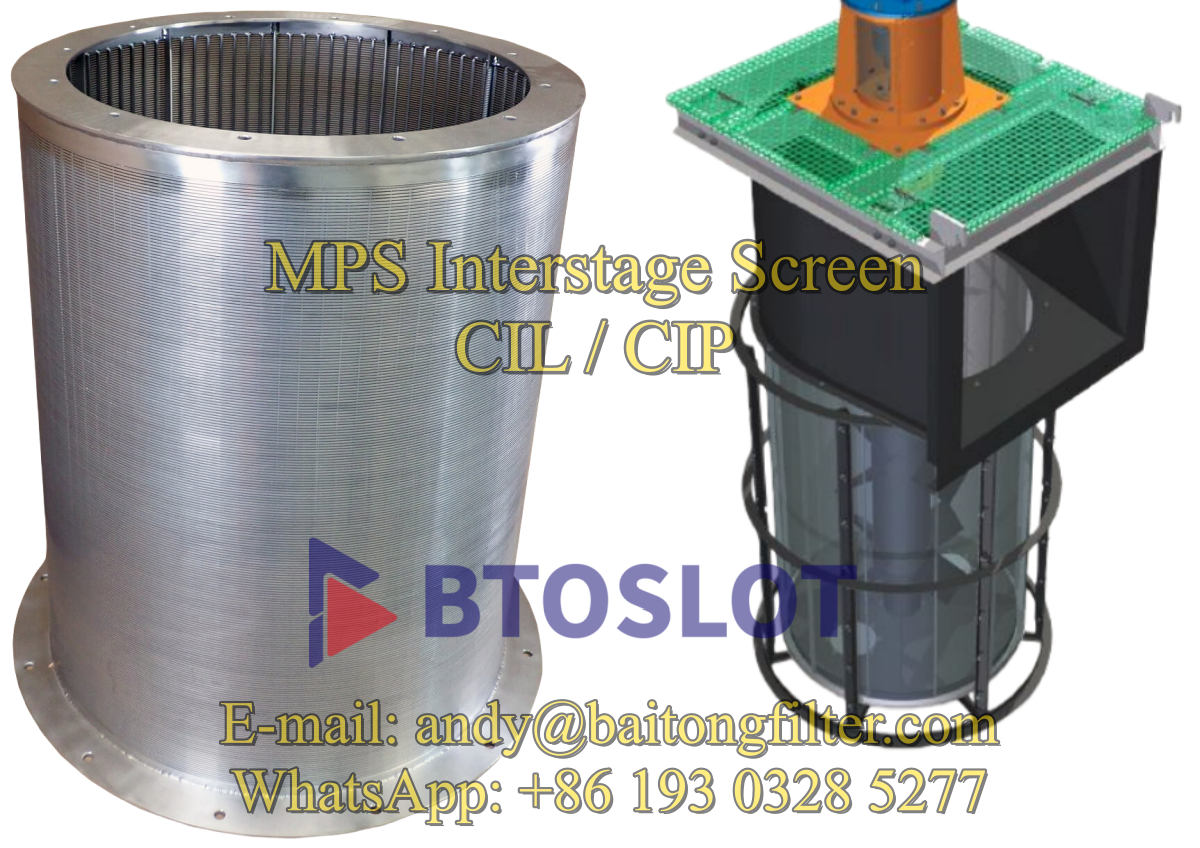
In gold mining Carbon-in-Pulp/Leach (CIP/CIL) processes, the efficiency of separating activated carbon from gold-bearing slurry is a core factor directly determining final gold recovery and production economics. For a long time, traditional flat perforated panels, as the mainstream gold ore screen, have exposed efficiency bottlenecks when handling fine-particle, high-viscosity slurries due to their inherent two-dimensional planar structure. Today, a Wedge Wire Screen (commonly known in the industry as a Johnson Screen), based on three-dimensional design, is revolutionizing carbon-gold separation with its structural advantages, driving CIP/CIL technology to new levels of performance.
The efficiency bottleneck of flat plate screens in carbon-in-pulp process
To understand the advantage of wedge wire screen structure, one must first see the limitations of the traditional flat screen. Traditional flat perforated screens, with their circular or square holes punched into steel plate, suffer from three main weaknesses:
Easy to clogging, Drastic Reduction in Effective Screening Area: Fine particles and fibrous impurities in the slurry easily adhere and accumulate at hole edges, quickly forming a "bridging" effect between apertures. This causes a sharp drop in active open area, forcing frequent production shutdowns for high-pressure washing or manual cleaning, severely impacting continuous operation.
Low Open Area, Limited Throughput Capacity: To maintain structural integrity, sufficient spacing must be left between holes, limiting the open area percentage (typically only 15%-25%). This lower open area creates greater flow resistance for the slurry, restricting the throughput capacity of a single unit or requiring larger equipment for a given processing duty.
Rigid Impact Point, Concentrated and Severe Wear: Slurry and activated carbon particles impact the flat screen surface perpendicularly, concentrating force and causing rapid wear around hole edges. Holes easily deform and enlarge, compromising separation accuracy and leading to abnormal loss of activated carbon.
The Innovation: Core Advantages of the Wedge Wire Structure
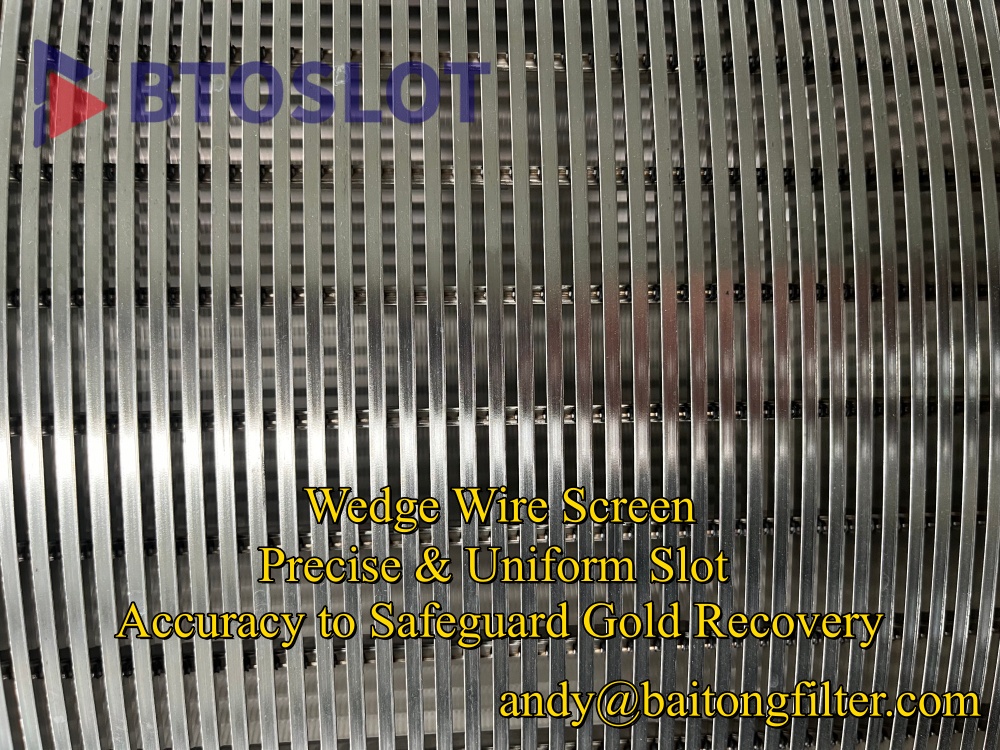
The Wedge Wire Screen fundamentally alters the screen surface geometry. It consists of profile wires (typically with a trapezoidal or "V" cross-section) precisely welded onto support rods in a parallel arrangement, creating a three-dimensional screening surface with continuous, uniform longitudinal slots. This structure delivers multiple efficiency gains:
"Self-Cleaning" Slots for Continuous, Efficient Separation: This is its most significant advantage. The slots formed by the wedge wires are streamlined, narrowing from top to bottom. As slurry flows across, particles make "line contact" with the slot, not "point contact". Any particle approaching or entering the slot is more likely to slide down the smooth wire surface and be discharged under gravity and fluid flow, unable to lodge in the narrowing gap. This dynamic "self-cleaning" action is key to enabling extended, uninterrupted operation in CIP/CIL circuits.
High Open Area & Optimized Fluid Dynamics: The 3D structure allows for a high effective open area (often 30%-40%) while maintaining excellent mechanical strength. Slurry flows with minimal resistance across the smooth wedge wire surface. This means a Johnson Screen can provide greater throughput in the same footprint, directly boosting the capacity of a single adsorption tank or screening station.
Exceptional Strength & Dimensional Stability: The "V" profile of each wire acts like a miniature structural beam, giving the screen surface superior resistance to bending and deformation. Under intense vibration and continuous slurry abrasion, slot dimensions remain stable over the long term, ensuring consistent separation accuracy. This prevents carbon loss or slurry "short-circuiting" due to screen wear, precisely safeguarding the carbon adsorption circuit and ultimate recovery.
A Full-Circuit Efficiency Boost: How the Wedge Wire Structure Empowers the Entire CIP/CIL Process
The efficiency advantages of the Wedge Wire Screen permeate multiple critical stages of the CIP/CIL process, enabling systemic optimization:
In Inter-Stage Screening: Efficiently retains larger activated carbon particles, preventing them from short-circuiting between adsorption tanks, while allowing fine, gold-bearing slurry to pass through rapidly. This maintains the concentration gradient crucial for counter-current adsorption, enhancing adsorption kinetics.
In Safety Screening: Effectively removes coarse impurities from the slurry that could damage pumps and valves. Its anti-clogging feature reduces maintenance frequency, ensuring stable operation of downstream equipment.
In Final Loaded Carbon Recovery: Achieves thorough and rapid separation of loaded carbon from barren solution. Its high-precision slots minimize carbon particle loss with tailings, directly impacting economic returns.
For any gold processing plant pursuing operational excellence, upgrading the gold ore screen at key screening points from a 2D flat panel to a 3D wedge wire structure is not a simple parts replacement. It is a fundamental technical retrofit targeting the bottleneck of separation efficiency. Through structural innovation, it simultaneously delivers longer runtime, greater capacity, more stable separation precision, and lower maintenance costs.
Conclusion
Moving beyond flat screens is more than a technological update; it is an evolution in separation thinking. The Wedge Wire Screen (Johnson Screen), with its unique 3D structure, perfectly meets the stringent demands for continuity, precision, and cost-effectiveness in CIP/CIL processes. In the core stage of carbon-gold separation, choosing this high-efficiency solution means injecting a more powerful and reliable engine into the entire process flow. It is a strategic step towards higher recovery rates and a lower total cost of operation.
Next: The Core Role of Johnson Screens in Gold Mine Carbon-in-Leach and Carbon-in-Pulp Processes
Previous: 2025 Annual Market Analysis Report for Stainless Steel Wedge Wire Screens
